Tonight, PBS will broadcast the first of an epic three-part NOVA series called "Treasures of the Earth: Gems, Metals, and Power." The 60-minute shows will take us on a stunning journey deep within the earth to discover the incredible forces of nature that forge gemstones, precious metals and other valuable resources.
"Our earth is a master chef," says geologist Lung Chan in the first episode. "She knows how to cook."
In the first hour, subtitled "Gems," NOVA literally crisscrosses the globe to get an insider's view of the gem trade— from the workshop of an iconic luxury jeweler in New York City to a sapphire mine of Sri Lanka, from North Carolina's emerald fields to the jade-laden Forbidden City of China.
Not only does NOVA cover the beauty, value and intrigue behind these exquisite treasures, but also delves into the amazing role these gemstones play in helping geologists unravel the mysteries of plate tectonics. NOVA will also explore the riches that may have originated in space.
"Treasures of the Earth: Gems, Metals, and Power" will air on November 2, 9 and 16. The second episode will cover precious metals and the third episode with tackle the subject of power as it relates to the control of natural resources.
In "Metals," NOVA will look at the astounding properties that have made them the pillars of human civilization. From the enduring luster of gold, to the conductivity of copper and the strength of steel, metals have reshaped societies and defined eras, according to NOVA.
In the third segment, "Power," the viewer will learn the energy secrets locked in the molecules of natural resources, such as coal, oil and natural gas. NOVA will also look at climate change and the hunt for cleaner forms of energy.
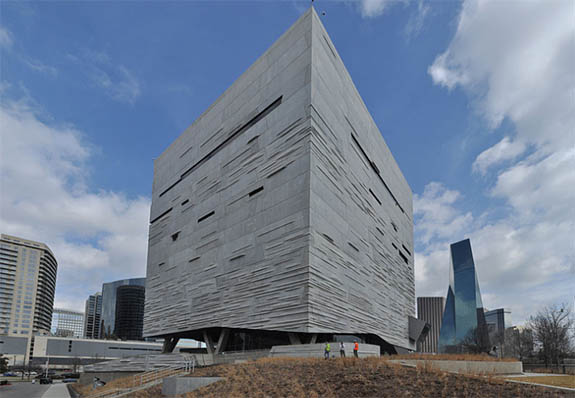
Topaz and citrine share the spotlight as the official birthstones for the month of November. And perhaps nowhere in the world can you see bigger and more magnificent examples of these gem varieties than at the Perot Museum of Nature and Science in Dallas.
You thought we were going to say "the Smithsonian in Washington, D.C.," but here's the catch.
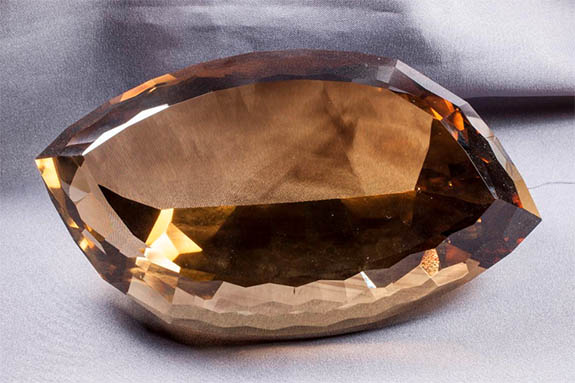
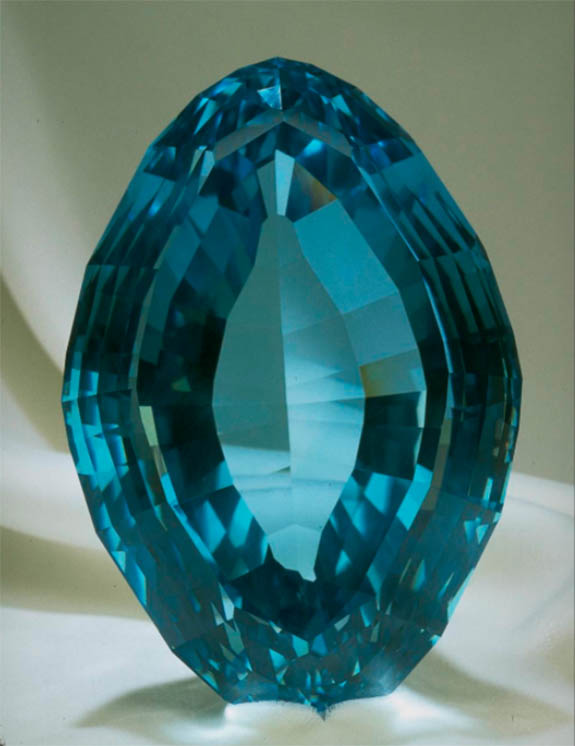
The Smithsonian has loaned 29 of its biggest faceted gems to the Perot Museum for a limited showing that runs through January 17, 2017. Among the specimens headlining the “Giant Gems of the Smithsonian” exhibition is the famous 22,892-carat American Golden topaz, a 19,747-carat smoky citrine and a football-shaped 7,033-carat irradiated blue topaz.
The American Golden Topaz is the third-largest faceted gemstone in the world. Sourced in Minas Gerais, Brazil, and tipping the scales at a whopping 10.1 pounds, the American Golden Topaz was cut by Leon Agee over a period of two years in the late 1980s from a 26-pound stream-rounded cobble owned by Drs. Marie L. and Edgar F. Borgatta.
In the top photo, the faceted gem sits in the foreground while two other natural topaz crystals are nearly the size of the seated young girl. They weigh 70 pounds and 111 pounds, respectively, but are not part of the Perot exhibit.
Sourced in Bahia, Brazil, the modified marquise-shaped smoky citrine was faceted in 1987 by Michael Gray and acquired by the Smithsonian in 2013. At 8.7 pounds, it's the largest smoky citrine in the National Gem Collection.
It's a common jewelry industry practice to irradiate pale-colored topaz, which becomes a brilliant blue after the process. The football-shaped gem you see here likely started out as colorless or pale yellow-brown, according to the Smithsonian. Discovered in Ouro Preto, Brazil, the 3.1-pound gem was gifted to the Smithsonian in 1981.
“Giant Gems of the Smithsonian” is making its temporary residence at the Lyda Hill Gems and Minerals Hall, which is one of the Perot Museum's most popular exhibits.
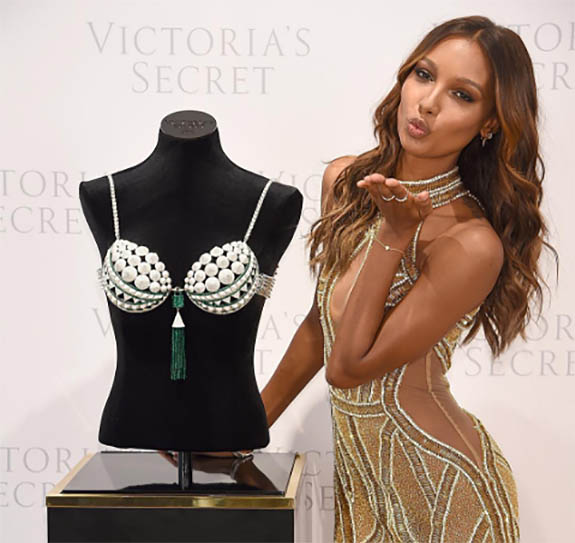
More than 9,000 diamonds and emeralds weighing 450 carats embellish the 2016 Bright Night Fantasy Bra by Victoria's Secret. The $3 million bra will be worn by model Jasmine Tookes at the 2016 Victoria’s Secret Fashion Show, which will be seen December 5 on the CBS Television Network.
This year's highly anticipated Fantasy Bra was conceived by Eddie Borgo, a New York-based accessories designer, who incorporated many of the elements from his jewelry and handbag collections.
“It was important to the Victoria’s Secret Fashion Show collection team that the design represented some of the different iconography, shapes and techniques that we use consistently within my namesake collection,” Borgo told Vogue.com.
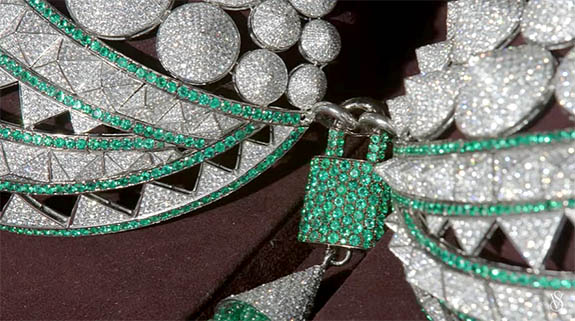
The result was an edgier design that features an emerald-studded padlock, emerald tassel, and diamond-encrusted spikes and studs. The jewels were handset in 18-karat white gold by AWMouzannar, a Beirut-based fine jewelry company with locations in London, Chicago and Kuwait City. The Bright Night Fantasy Bra took seven months and more than 7,000 man-hours to create. Behind all the embellishment is the company's "Beautiful by Victoria’s Secret" bra.
Borgo was excited to work with emeralds, claiming he was drawn to the stone's vividness.
“The color of a true emerald is inimitable,” he said.
Tookes, who was in New York City last week to unveil the new Fantasy Bra, also was excited by the inclusion of emeralds in the design.
“They are one of my favorite gemstones," she told Vogue.com. "I have a lot of rings that have emeralds on them, so this matches perfectly with my jewelry collection.”
When it came to fitting Tokes for the $3 million bra, Borgo left nothing to chance. The designer utilized a virtual scan on Tookes's body as well as a plaster mold.
Tookes was surprised to become the latest in a series of high-profile models to have the honor of wearing the Fantasy Bra. She follows in the footsteps of supermodels Gisele Bündchen, Claudia Schiffer and Tyra Banks.
“It’s such an honor for me to join a whole group of women who are icons, and who I grew up watching over the years,” Tookes said.
For the first time in its history, the Victoria’s Secret Fashion Show will take place in Paris.
Credits: Instagram.com/VictoriasSecret; screen captures via vspressroom.com.
Welcome to Music Friday when we bring you great new songs with jewelry, gemstones or precious metals in the title or lyrics. Today we shine our spotlight on the newly engaged Colbie Caillat, who sings about falling in love in her brand new release, "Goldmine."
Composed by Caillat and three collaborators, "Goldmine" captures the elation of finding the perfect soulmate. Billboard magazine described "Goldmine" as "a sunny number that's liable to have you whistling along in glee."
Caillat sings, "Fly me back to the moon where you took me / The very first time that you kissed me / In the sweet starlight of your endless eyes when you lit this fire / Feels like we're sitting on top of a goldmine / Flame so bright that it won't die / In a billion years it'll still be here 'cause our love is a goldmine / Yeah, our love is a goldmine."
"Goldmine" is the second track on Caillat's new album, The Malibu Sessions. The single stands at #37 on the Billboard Adult Top 40 chart, and the album, which was released October 7, is climbing the Billboard 200 and is currently at #35.
Caillat told Billboard magazine that "Goldmine," which was originally penned by Taylor Berrett, was passed along to her by a mutual friend, Kara DioGuardi.
"Within three minutes of hearing [Berrett's] idea I was singing it on repeat," she told Billboard. "I ran upstairs and played it for Jason Reeves [her regular writing partner) and we instantly started writing to it. We called Kara on Skype so the three of us could write it together. She was at her cozy house in Maine and we were at our beach house in California. Within minutes we finished the song and started recording it right away. This happy, warm song is definitely one of the most unique ways I've ever written."
The song meshed perfectly with Caillet's own experience. She started dating guitarist/singer Justin Young in 2009 and the couple was engaged in May of 2015.
A native of Malibu, Calif., the 31-year-old Caillat got national attention in 2008 when she recorded "Lucky," a duet with Jason Mraz. The song earned a Grammy in the "Best Pop Duo/Group Performance" category. Caillat has sold more than 6 million albums and 10 million singles worldwide.
Some trivia: Caillat's road to stardom has not always been paved with gold. The artist auditioned for American Idol twice and was rejected both times. Caillat rose to fame through social networking website Myspace.
Please check out the uplifting video of Caillat's live performance of "Goldmine" at Paste Studios in New York City. The lyrics are below if you'd like to sing along...
"Goldmine"
Written by Taylor Berrett, Kara Elizabeth DioGuardi, Jason Bradford Reeves and Colbie Caillet. Performed by Colby Caillet.
If all I had was a dollar and your bright smile
I'd have a dollar more than I would need to get by
'Cause I'm a billionaire if you count every sunrise
Waking by your side and every good night
If all you had was the way that I love you
You'd have more honey than the honey bees in June
I'll keep you laughing, keep you smiling, keep your dreams true
Long as I have you, nothing we can't do
Fly me back to the moon where you took me
The very first time that you kissed me
In the sweet starlight of your endless eyes when you lit this fire
Feels like we're sitting on top of a goldmine
Flame so bright that it won't die
In a billion years it'll still be here 'cause our love is a goldmine
Yeah, our love is a goldmine
If everything we ever owned disappeared today
We'd build a castle in the sand somewhere far away
Don't need no money, no TV, don't need no microwave
Just the ocean waves and the love we make
Fly me back to the moon where you took me
The very first time that you kissed me
In the sweet starlight of your endless eyes when you lit this fire
Feels like we're sitting on top of a goldmine
Flame so bright that it won't die
In a billion years it'll still be here 'cause our love is a goldmine
We'll be rich in wrinkles, old and gray
When the rising tide sweeps us away
Until then fly me back to the moon where you took me
The very first time that you kissed me
In the sweet starlight of your endless eyes when you lit this fire
Feels like we're sitting on top of a goldmine
Flame so bright that it won't die
In a billion years it'll still be here 'cause our love is a goldmine
Feels like we're sitting on top of a goldmine
Flame so bright that it won't die
In a billion years it'll still be here cause our love is a goldmine
Yeah, our love is a goldmine
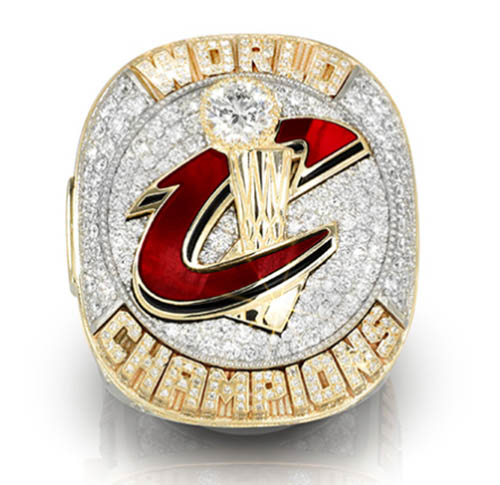
The Cleveland Cavaliers commemorated their first-ever NBA crown Tuesday night with super-symbolic championship rings that reflect the spirit of a team that defied all odds to become the first in NBA history to overcome a 3-1 series deficit.
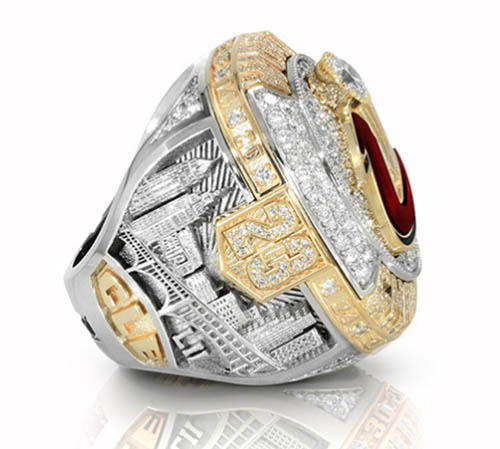
Designed in 10-karat white gold with 14-karat gold accents, the rings are encrusted with more than 400 diamonds weighing 6.5 carats. The massive 165-gram, two-tone rings are the league's heaviest to date.
When the Cavaliers beat the Golden State Warriors in Game 7, 93-87, they completed a thrilling run that delivered to the City of Cleveland its first major sports championship in 52 years.
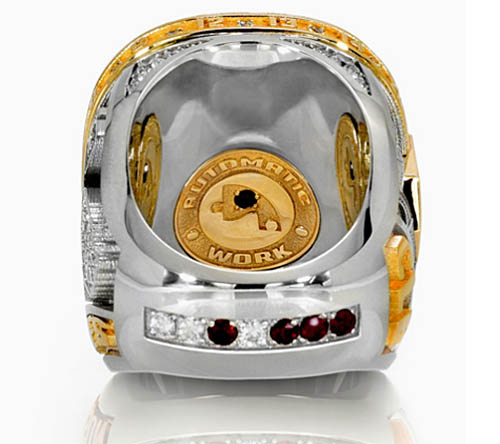
The most interesting part of the design is the way manufacturer Baron Championship Rings represented the team's unprecedented comeback. Set into the bottom of the band are seven gemstones. The white diamonds represent the Warriors' victories in Games 1, 2 and 4, and the deep red garnets represent the Cavaliers' victories in Games 3, 5, 6 and 7.
The face of the ring features the Cavaliers' "C" logo carved from a dark red garnet. The "C" has a black drop-shadow that represents the lucky black-sleeved uniforms that helped turn the series around in Game 5.
The basketball atop the Larry O’Brien Trophy on the face of the ring is replaced by a one-carat round diamond, signifying the team's first championship.
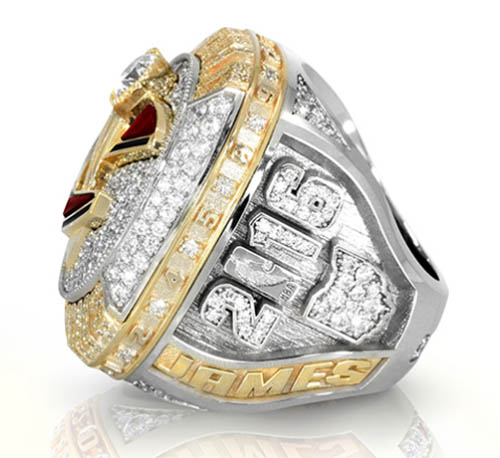
The words "WORLD" and "CHAMPIONS" border the top and bottom of the ring in contrasting yellow gold. The words are rendered with 216 diamonds, a nod to Cleveland's area code. Cascading along the right and left edges of the ring are 46 diamonds, representing the number of years the Cavaliers have been in existence.
Encircling the top of the ring are the numbers of each of the players rendered in gold and spaced by a diamond. In addition, each ring has a custom yellow gold banner that features the player's number encrusted in diamonds. The banner hangs over the skyline of Cleveland rendered in white gold. The Roman numerals "LII" sit under the bridge. This represents the 52 years the city had been waiting for a championship. The drought is now "water under the bridge." Also under the bridge are Cleveland's initials "CLE" in raise gold lettering.
The opposite shoulder of the ring shows the player's last name in 14-karat yellow gold along with the championship year of 2016 in white gold. The "0" in the year is replace with the NBA logo. Under the year is the shape of Ohio encrusted with 11 diamonds to signify the number of years the team has been under the current ownership.
On the interior of the ring is one of 16 puzzle pieces and the team's chant, "Automatic Work." The puzzle represents a motivational strategy used by management to propel the team through the playoffs. Each player and head coach Tyronn Lue were assigned a puzzle piece that, when fully assembled, depicted the image of the Larry O'Brien trophy. The team knew that it would take 16 wins (or puzzle pieces) to win the championship.
The black diamond punctuating the puzzle piece is a second nod to the black-sleeved uniforms that sparked the team's turnaround.
The Cavaliers received their rings prior to their victorious home opener against the New York Knicks on Tuesday night. More than 2,000 full- and part-time employees of the Cleveland Cavaliers' organization will receive replica rings.
Credits: Images courtesy of Baron Championship Rings.
Many eons ago, the Orange River ferried precious diamonds from the center of South Africa westward all the way to the Atlantic coast — eventually scattering millions of carats across the ocean floor.
Today, five massive production vessels operated by De Beers — in partnership with the government of the Republic of Namibia — are recovering those gem-quality diamonds from a remote location more than dozen miles off the southwestern edge of the African continent.
The operation, called Debmarine Namibia, employs a 285-ton vacuum that scours the ocean floor 400 feet below sea level. A seabed crawler uses flexible hoses to bring diamond-bearing gravel to the surface. According to The Wall Street Journal, the mining operation yields a handful of diamonds for every 180 tons of material processed.
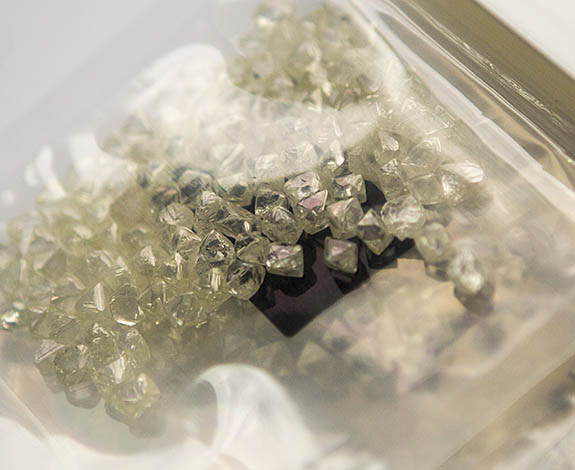
The publication described the fleet's high-security recovery rooms, where X-ray machines help separate the diamonds from worthless gravel. The concentrate is collected in jam-sized jars and taken to De Beers's land-based sorting operations via helicopter a few times each week.
When the undersea terrain is too uneven for the giant vacuum, the focus turns to the other ships, which use use drills to probe and extract material just 18 inches below the surface. There is no need to drill deeper because the diamonds are scattered just below the top layer of gravel.
A few decades ago, it would have been unfathomable for diamond companies to pursue deep-sea mining. But breakthroughs in technology are making this type of project viable and lucrative.
While sea-based diamonds account for just 4% of De Beers's annual production by carat weight, they account for 13% by value. This is because 95% of the diamonds pulled from the ocean floor are of gem-quality. This compares to just 20% of gem-quality diamonds coming from De Beers's top mine in Botswana. Some experts surmise that the diamonds in the ocean have endured such a pounding for so long that only the gem-quality ones could stay intact.
The Debmarine Namibia operation has yielded 16 million carats, so far. De Beers predicts that it will take about 50 years to "mine out" the licensed area that covers 2,300 square miles. It starts about 3 miles offshore and extends seaward 10 to 20 miles.
De Beers has aggressively invested in its sea-based operations. In August, the company added to its fleet the SS Nujoma, a $166-million exploration and sampling ship.
Credits: Images courtesy De Beers. Map by GoogleMaps.com.
A lavish diamond necklace worn by Catherine the Great 250 years ago is one of the highlights of Sotheby's Magnificent Jewels & Noble Jewels auction in Geneva on November 16.
The jewelry offers a rare glimpse at the grandeur and elegance surrounding the Russian Royal Family and, specifically, Catherine II, Empress of Russia. One of the great leaders in Russian history, Catherine the Great (1729 – 1796) commissioned the diamond necklace and bowknot clasp as two separate pieces between 1760 and 1780.
Catherine the Great was a connoisseur of fine jewelry. Her magnificent collections were crafted by the most highly skilled French jewelers. Sotheby's noted that stylistically, the necklace with bow clasp is consistent with traditional designs of the late 18th century, which would have been fastened around the neck using a ribbon or stitched directly onto clothing.
The necklace boasts 27 graduated cushion-cut diamonds in open settings on an articulated band. The ribbon bow clasp also features cushion-shaped diamonds in an openwork floral pattern. The jewel carries a pre-sale estimate of $3 million to $5 million.
According to Sotheby's, the survival of an 18th century jewel of this stature is almost unheard of outside royal or museum collections. Oftentimes, these pieces from the 1700s would have been broken up or reworked to align with later fashions.
At the outbreak of the First World War in 1914, the Russian Imperial treasure was moved from St. Petersburg to Moscow, and the jewels were stored in sealed cases in the Kremlin. Thirteen years later, a number of items — including the diamond bow necklace — were taken to London and offered at auction at a sale of “The Russian State Jewels.” For the next 89 years, the diamond necklace with the bow-shaped clasp would be possessed by only two private collectors.
Interestingly, the current owner obtained the necklace at a Sotheby's auction in 2005. At that time, it sold for $1.5 million, which was on the high end of the pre-sale estimate.
Also expected to fetch $3 million to $5 million at Sotheby's Geneva sale is a suite of colored diamond jewels that date to the early 1700s and are suspected to have ties to Russian royalty.
The jewelry suite — which includes a necklace, brooch and earrings — contains colored diamonds that may have been part of a gift Empress Catherine I of Russia (1684-1727), wife of Peter the Great, gave to Sultan Ahmed III to negotiate the end of the Siege of Pruth in 1711. Apparently, the Sultan accepted the sumptuous gift, leading to a peace treaty between Russia and the Ottoman Empire.
The gemstones were then used by the Sultan Abdul Hamid II (1842 – 1918) for the present necklace, which he offered to the wife of Teufik of Egypt, possibly for the birth of the last Khedive of Egypt and Sudan in 1874, according to Sotheby's.
“These two stunning jewels carry with them a fascinating insight into the luxury and opulence of the Russian court," said David Bennett, Worldwide Chairman of Sotheby’s International Jewelry Division. "It is difficult to overstate their rarity and historical importance, and I am thrilled to be able to present them side by side this autumn."
Jonny Ritz & Company, Inc. was founded over 20 years ago when Jonny realized, with his unique five year jewelry/gemology education, he could offer a wealth of knowledge, coupled with personal service, and non-retail pricing to a jewelry buyer.
Jonny meets with clients in his office in Los Angeles, but phone consultations are not uncommon for out of town customers.
The business has grown on a referral basis to a large clientele with friends of friends, co-workers and relatives sharing their satisfaction with the unique buying process at Jonny Ritz & Company.
One of Jonny’s favorite sayings is, “It’s best to make a little bit of money from the same good people for a lot of years.”
Whether it is a unique custom piece or an item pictured on www.jonnyritz.com, Jonny will ensure that you are 100% satisfied.








 Posts
Posts


